

“Where is your North Star?” he asks me. “Keep your eye on it when you write.”
“I am trying to find one through my interviews!” I say. I was sensing where he was going, and wanted to wriggle out of the gravity of it.
“Well, you can always find it in the sky if you look.” …He is right. I’ve taken it as advice for my own work: stay true to your core.
I’ve been writing “Mingei Through Dialogues” newspaper column for three years now, and Senro Sato is the person I have spent the most time listening to. Despite being in his mid-eighties, his memory is vivid, his humour sharp, and he is always full of gems for thought to collect. Such as:
“Environment gives birth to an object, not an individuality.”

He was referring to the time when Mingei, folk craft, was “discovered.” Things that were born out of everyday life, most likely out of necessity rather than an intention to create. Things shaped by daily life, by the materials and environment around them, somehow becoming beautiful without anyone setting out to make them so. That is…or was, Mingei.
The trending phrase “Life with Mingei” is only a testament to the fact that our life has grown apart from Mingei…he says. A sad truth.

Senro is the eighth of ten siblings, born in Hachinohe, Amori, the northernmost part of Japan main island. His family ran a local shop selling everyday necessities. “I grew up surrounded by Mingei”
During his art university time, he encountered the art of urushi lacquer, made by Living National Treasure Gonroku Matsuda.
“Can human hands make something this beautiful?” At that moment, he became convinced that urushi was the material that could communicate the beauty of the Japanese spirit.
Urushi itself is perhaps the very embodiment of something born from its environment. The urushi tree dies after giving us a cup of its sap. There’s someone who gathers the urushi sap, then someone prepares the wooden base, and finally Senro applies urushi, layer by layer.
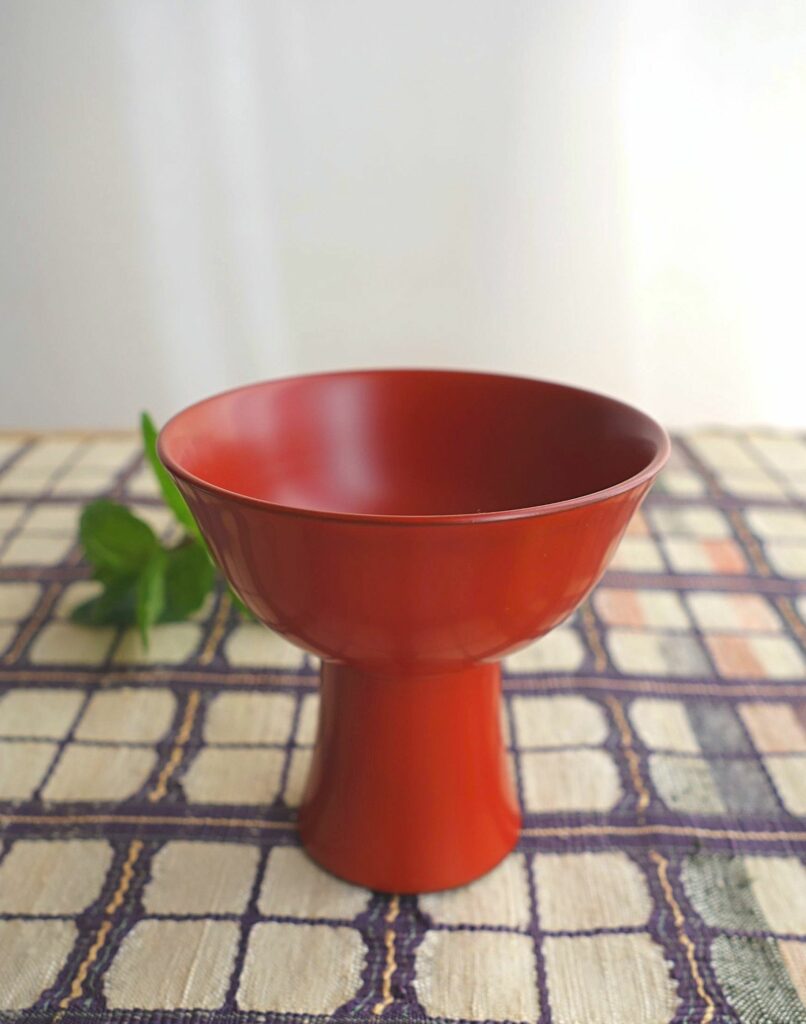
Even the reinforcing materials mixed with the lacquer come from the local earth. Brushes, wooden spatulas… every step, material, and tool is an integral part of the environment that makes urushi lacquerware possible.

As a urushi craftsperson, Senro understands the weight of his own words. “Environment gives birth to an object, not an individuality.”
To communicate Mingei, then, is not simply to talk about objects from the past. It is to help create the kind of life and environment in which Mingei can be born again. That is why he believes:
“The Mingei movement has to be a social movement.”
Black and white photos courtesy of Sayaka Takizawa
More about Senro Sato
Short movie on the process of Urushi Lacquer making
「人で巡る信州の民芸」で掲載した佐藤阡朗さんの日本語版記事はこちらから。(無料会員登録でお読み頂けます)
0 Comments